xmlns:og='http://ogp.me/ns#' The Font of Noelage

Wednesday, 15 May 2019

The unfinished story of a classic workplace con job.


Playing practical jokes on workmates was once a very popular pastime. It is not so prevalent these days. This is no doubt due to the arrival of the Political Correctness Virus and the propensity for some people to sue at the drop of a hat.                                                                                                                                                                                                                                                                                                                                       My father often used to have us laughing at the family tea table as he told of tricks played by workers on one or more of their co-workers. A frequent and fairly basic story was of the foreman telling a young, newly employed  lad to go to the hardware store and get a left handed screwdriver, or chisel, or hammer or shovel. Another variation was to ask the victim to go to the paint store and buy a tin of striped paint.                                                                                                                                                                                                                                                                                                 Of course, other schemes were much more complicated. One of the most complicated schemes I ever heard of was one devised by Maurie Carr. The bizarre thing is that this story was told to me as I entered the church for Maurie's funeral.

Maurie was a very well-respected journalist, although, he  actually preferred being a sub-editor, where he could re-write somebody else’s words. The fact is that he wrote wonderful words full of whimsy and wit. He finished his colourful newspaper career  as a much-loved columnist at the Daily News.

Maurie started at Perth’s Daily News in the early 1950s. He moved to the Melbourne Herald in 1956. It was at the Herald that Maurie started having severe differences of opinion with its new proprietor, Rupert Murdoch. He had these differences throughout his career when working on a Murdoch paper. From 1958, he worked on the Sydney Truth, The Daily Telegraph and the Canberra Times. He even worked overseas for The Times of London in the late 1960s. For a while in Canberra, Maurie was press secretary to the Deputy Prime Minister, Country Party leader, John “Blackjack” McKeon.                                                                                                                                                                                                                                                                            In the late 1960s, there was another stint in Melbourne on the Sun newspaper, also owned by Murdoch. In the early seventies, Maurie returned to The Daily News where he soon became a much-loved columnist until the dear old Daily News folded in the 1980s
Maurie and his brother, Raymond, were my much loved cousins. We were more like brothers, really. Maurie and Raymond’s father, Maurice Carr died of a miners’ lung disease in 1930, when Maurie was three and Raymond was just six months old.                                                                                                                                                                                                                                                                                                                                My father, Jack Bourke became a surrogate father to my two cousins when he was courting their aunty, my mother, in the 1930s. After my parents married in 1936,  Maurie and Raymond used to spend a great deal of time at our house in Inglewood. After the war, when my parents were waiting to get a building permit to build a new home in Mt Lawley, we all lived together with my extended family at 8 Aberdeen Street, from 1947 till 1951. Maurie's mother, my Aunty Millie managed the boarding house. Living at the big two storey boarding house at Number 8 were my parents, my two younger sisters, my grandmother, my Aunty Millie,  Maurie and Raymond, and my mother’s two unmarried siblings, my Uncle Ray and Aunty May. A few other interesting people also boarded in the big, rambling two storey house. Every day was a great adventure.

Maurie enjoyed a joke. He and his newspaper workmates often played pranks on each other. Most of the journalists and sub-editors at the Daily New were all ex-servicemen from World War 2. Most of them were ex RAAF. It seems that playing practical jokes on each other was away of relieving the tedium of the war. That practice carried over into peace time.

The story I am about to relate was told to me as I entered the Catholic church in Palmyra to attend Maurie’s funeral Mass in February 2007. I entered the church filled with great sadness, and some anxiety, as the family had asked me to deliver Maurie’s eulogy. I was hoping I could hold myself together through it all. On entering the church I saw a very old friend of Maurie’s sitting in a seat at the entrance. He was Keith Flanagan, an old reporter mate of Maurie’s from the 1950’s at the Daily News. Maurie used to often talk about Keith and some of the escapades they got up to.

I had met Keith over fifty years ago. In those days Maurie worked on Saturdays for The Weekend News, a subsidiary of the Daily News. He used to write up the football. He always covered the East Perth games at Perth Oval. Invariably, at about twelve thirty on a Saturday, Maurie would breeze into 8 Aberdeen Street, with a newspaper mate, to have lunch with our extended family. Then he would head off to Perth Oval. I remembered that Keith had been among those unscheduled lunch guests more than fifty years ago.                                                                                                                                                                                                                                                                                              I introduced myself to Keith and thanked him for coming. Keith, older than Maurie, was very frail. He immediately grasped my arm and said, “Maurie was a real wag. Do you know some of his stories?” I replied that I knew Maurie had led a colourful life. That he and his good mate Ron Saw got into all sorts of mischief in Perth and later in Sydney, where Ron was a columnist for the Bulletin Magazine.                                                                                                                                                                                               “I bet you don’t know this one”, said Keith as I watched my wife and other family members walk on to sit in the front pews. This is Keith's Maurie Carr story...

One Monday morning at the Daily News in the early fifties, Maurie and I were sitting at our shared desk. A young journalist came into the newsroom looking as  he had seen a ghost. Maurie called out, “What’s up Bill? You don’t look too flash.”
They young fellow replied, “Oh, I have done a terrible thing. Oh! I don’t know what I’m going to do.”  He was very upset.

“Want to tell us about it?” asked Maurie. “Sometimes, talking about a problem can help.”                                                                                                                                                                                               Bill said that nothing could help his problem. He told us that for a few weeks he had been seeing a girl named June. On Friday night he had called around to see if she  wanted to go to the pictures, or maybe have a drink somewhere.                                                                                                                                                                                                                                                             June's mother answered the door. Her name was Shirley. She was war widow; her husband having been killed in action in New Guinea in 1943. She told Bill that June was not home She was at friend’s house. She was going to be her friend’s bridesmaid in a month or so and they were planning the wedding. June was going to stay overnight.
Bill continued, saying that , “Shirley is blonde, in her late thirties or maybe very early forties. She could pass for June’s older sister.” Bill told Shirley he was sorry June was out because he wanted to ask her if she would like to go to the pictures or maybe go for a drink somewhere.

“We chatted for a bit. I said goodnight to Shirley and was turning to leave when she said, ‘Well, would you like to come inside for a drink?’”  Bill had nothing else planned, so he said OK. Shirley opened a bottle of beer and offered him some cheese and biscuits. “ After we had had a few drinks she put on a record and then we danced. And…then...and…then...I stayed the night!” blurted out an embarrassed Bill. “What am I going to do? I will never be able to look at June again. Or Shirley!"

“Nothing to worry about, Sport,” Maurie replied, soothingly. “Shirley’s never going to tell June what happened. Just carry on as usual.” Bill, of course, was not so sure, but Maurie was very persuasive.  Bill calmed down and walked over to his desk in the newsroom.
Later that day, Maurie visited the newsagent’s in Zimpel’s Arcade, across the road from Newspaper House in St George’s Terrace. He returned to the newspaper office and visited a girl he knew in the typing pool. He asked her to write on a lavender blue card that had “Thinking of you” embossed on the cover. In her feminine hand, the young typist wrote, under Maurie’s dictation, “Dear Bill. Thank you for a truly wonderful evening. I look forward to seeing you again. Love, Shirley.”                                                                                                                                                                                                                                   Maurie put the card in an envelope and addressed it to Bill care of Newspaper House, St George’s Terrace. He posted it in the post box on the ground floor of Newspaper House. The next day an ashen faced Bill came to Maurie and Keith’s desk. ‘She ‘s written me a note. A note! She wants to see me again,” said a very disturbed Bill.
She’s just being polite,” cautioned Maurie. “You obviously made her very happy. She’s just letting you know. You’ve no need to worry.”                                                                                                                                                                                                                                                                                                        Well, of course Bill was extremely worried, but Maurie again persuaded him that everything would be alright and Bill moved off to his work desk. Maurie purchased another card that day. Its cover said, “To my Sweetheart”. This time Maurie had his friendly typist write, “ My Dearest Bill. Please call me soon. I cannot wait till I am once more lost in your loving embrace. Forever yours, Shirley.”  Maurie posted the card that afternoon.

 A day later, Bill burst into the newsroom waving his latest card from Shirley. He was bereft, until the very persuasive Maurie calmed him down and convinced him that Shirley would not really do anything about it. "She'll be thinking of her daughter's feelings" Maurie told him.
That afternoon, Maurie had a longer conversation than usual with the Copy Boy, a young lad who took reporters’ stories to the compositors in the Print Room.

On the Friday morning, Bill entered the Newsroom. Maurie cheerily asked if he’d had any more cards from Shirley? With a relieved smile Bill said that he hadn’t. Maurie smiled and gave a big thumbs up as Bill moved to his desk.

At Around about 10-00 am the copy boy went to Bill’s desk. He told him there was a lady at reception asking to see him.

“A lady. What lady? What’s her name?” asked a very agitated Bill. The copy boy, who had been well schooled by Maurie, told Bill that she was an older woman.

”Maybe, it’s your mother” suggested the copy boy, quoting Maurie’s line word for word.                                                                                                                                                                                                                                                                                                                           Bill went white. “Tell her she can't see me. Tell her I am too busy to see anyone today.”                                                                                                                                                                                                                                                                                            The copy boy left the newsroom. He reappeared about two minutes later and told Bill, “The lady said she won’t leave. She said if you don’t’ come down to reception within five minutes, then she is coming up here.

Bill gave out an agonised cry and fled the newsroom, via the door to the print room.
Keith Flanagan described Bill’s departure with great glee. “Oh, yes, Maurie was a wonderful fellow. We had great times together.”

Well, by now the mourners were all seated and the priest was moving out of the sacristy on to the altar. Maurie’s funeral was about to begin. I said goodbye to Keith and hurried to take my seat next to my wife and family.

I did not see Keith Flanagan after the funeral. He lived in Lesmurdie. A fellow journalist told me Keith caught a taxi straight after the service concluded. Two months after Maurie’s funeral I read Keith Flanagan’s death notice in the morning paper.

So, I did not get to ask Keith how the story finished. Did Bill eventually marry June? Maybe he married Shirley? How did Maurie and Keith act when a shaken and dishevelled Bill turned up for work the next day? If he turned up for work, that is. How did Bill react when he learned he had been conned.

My belief is that Bill showed up for work and Maurie confessed that it was all a joke, that Shirley had not written on any cards or stalked him at newspaper House. No doubt Bill would have been justifiably angry at the way he had been treated.

In his fury, did Bill try to knock Maurie’s block off?  Probably not. Maurie was the heavyweight boxing champion at Aquinas College in 1943. After he left school he joined the air force  and spent a lot of time in the RAAF boxing at Inter Service bouts in Melbourne and Perth. He did quite well against some of the U.S. Navy’s best boxers.

Maurie was a very charming and likeable chap. People liked being in his company. Bill would not stay mad at him for too long. If I was ending the story, I would say that Bill, relieved to have Shirley off his back, eventually came to see the funny side of things. Maurie, with his charming smile, would sincerely apologise.

Then he, Keith and Bill, after a few laughs, would wander over to the front bar of the Palace Hotel, where most of the Daily News journalists and sub editors finished up after the country edition of the paper went to press at 10-30a.m. each day.

Maurie would have bought the first of several rounds. So, everything turned out alright in the end.
But, we'll never, ever know, will we?



Wednesday, 3 April 2019

English as she is parlezed!


English as she is parlezed.
I cannot speak French, so I am unsure if the title of this story is the title that I want. Maybe it will become clearer, Dear Reader, as the story progresses. I actually can speak a little bit of French. In my youth I could say Champs Elysee, Tour Eiffel, Danielle Darrieaux and Brigid Bardot.

 Way back in 1983, when I travelled through Europe in a campervan with my family (now, there is a story), I learned to order a baguette by saying, “Cher verdrae, un baguette, si vouz plait”. I cannot vouch for my French spelling, but that is what I would say to the shop girl whenever I wanted a baguette. Of course, as soon as I said it the shop girl would burst out laughing and I would have to point to the bread stick that I wanted.

Having digressed from my theme before I even started, I will try to get back on track. In my childhood days I used to go to the matinee movies at the Civic Theatre in Inglewood  on Saturday afternoon. We did not call them movies those days. We called the “The flicks”.
It was in a time during, and just after, the world war, the second one. Many of the films would be about Errol Flynn or John  Wayne fighting heroically against the Germans. Any Germans that appeared in the film would speak English but with a very heavy German accent. Films did not seem to have sub titles in those days.

In fact, the first sub-titled picture that I that was, “Bitter Rice”. I saw it around 1956 in the Liberty Theatre in Murray Street. The Liberty used to only show foreign films, which was a nice way of saying Rude Pictures. You had to be over 21 years of age to get in. I was only 17 at the time but I wore a gabardine raincoat and a scarf to smuggle myself past the stunningly beautiful usherette. I can still remember her. She was tall, blonde, with long legs. Around her ankle she wore a thin gold bracelet, which, in  1956 was the sign of a very bold and brazen hussy. She smiled at me as she took my ticket.

“Bitter Rice” was an Italian movie starring Sylvano Mangano, a voluptuous, dark haired beauty who spent most of the film leaning over in rice fields. She had large breasts and a small blouse which made the leaning over quite breathtaking at times. When I wasn’t looking at the lovely Sylvana’s blouse, I read the English sub titles that appeared at the bottom of the screen. When the picture finished, I walked up Hay Street and turned into William Street. I waited just outside the Metro Theatre in William Street for the number 19 bus to take me home to Mt Lawley. While I was waiting, I studied the books in the bookshop window next door to the Metro Theatre. I was surprised to see that one of the books featured in the window display was “Bitter Rice”. Since then, I have always claimed to be one of the very first people in the world to have “Read the movie and seen the book.”

Of course, since the mid fifties many, many films have been made with subtitles and, not only foreign films. From the 1960s onwards, film makers could have English speaking movies with the Germans speaking in German and having English subtitles underneath.

Recently, however I have been intrigued by the latest artistic techniques of film makers and the use of language and sub titles. I first noticed this in the detective series, Maigret, starring Rowan Atkinson in the title role. Maigret is a fictional French detective created by Georges Simenon. In this TV series all of the actors spoke English. I cannot recall any subtitles, but all the signage was in French. I thought it a bit odd that, despite having all the French characters speaking English, the newspapers, street signs and store fronts were all printed in French.

I became even more intrigued when I watched the latest TV adaptation of Victor Hugo’s classic, Les Misérables. When I was a boy, I loved comics. My favourites were Superman, Captain Marvel and Classics Illustrated. The latter came out monthly and were extremely well written and illustrated stories of classics such as Moby Dick, The Man in the Iron Mask, Captain’s Courageous, Two Years Before the Mast, A Tale of Two Cities, A Christmas Carol, Black Beauty and so on.

On the last page of each issue they would print graphic information about next month’s classic tale. At the time, I was living in Aberdeen Street, Perth, with my very extended family, which included my two older cousins, Maurie and Raymond Carr. I was probably about ten years old. I idolised my older cousins and, in an effort to impress them, I told them I was looking forward to reading the next issue of Classics illustrated because it was all about a fellow named Les Misérables. Well, Maurie and Raymond fell about laughing. Eventually, they explained that Les Misérables was not the name of a person. It was French for “The wretched” and was pronounced phonetically as Lay Mizz-er-rahb. (See, even aged ten, I could speak French).

This latest screen adaptation of Les Misérables has respected British actor, Dominic West playing the central character, Jean Valjean. Now the story is obviously set in France but, as in Maigret, all the characters speak English. The high-ranking French characters speak excellent English. The quality of the spoken English descends downwards; those on the lower rungs of society speak with thick East London or cockney accents.

Again, as in Maigret, despite the English dialogue, the signage is in French. It gets more complicated, because occasionally, these English-speaking French characters will start counting out money in French, greet each other with Bonjour or occasionally speak English with a French accent. It can be confusing.

Actually, I am already confused because the arch villain of Les Misérables is Inspector Javert of the French Police. I first saw Javert portrayed on the screen in a 1930s film in which Frederick March played Jean Valjean and Charles Laughton gave an unforgetable performance as Inspector Javert.       

For some reason, the film makers of this latest picture decided that Javert’s character would be portrayed by what I would have called a negro, but I believe negroes no longer exist. Apparently, negroes have been killled of by Political Correctness.  In this TV series, Javert is a coloured man who speaks impeccable English.

Then, along comes Wallander. The British TV series starring Kenneth Branagh, not the Swedish series starring a Swedish person who speaks Swedish and has English subtitles. In the British TV series of Wallander, which are being re-run on Perth TV at present, everyone speaks English, even Branagh, who disguises the fact that he can speak commanding English, like Sir Lawrence Olivier, by talking like a ventriloquist with very  little lip movement.

What is really strange about this Wallander series is that, despite everyone speaking English, not only is all the signage in Swedish but they text each other on their phones in Swedish. Thankfully, English subtitles tell us what the Swedish texts say. Not only that, the other night Wallander was using his computer to chat with a lady he was growing fond of. When it showed us his word processor screen, all of the text was in Swedish. Subtitles told us what was going on in this embyonic cyber romance

Thank goodness for those English subtitles where people speaking in English write and read in foreign languages.

I hope my story’s title makes some sort of sense, now?


Friday, 22 February 2019

A bumpy ride to Paradise.


Recently, Tom Zaunmayer, a journalist in the Pilbara, wrote a very  entertaining story of his bumpy four-wheel drive rides  to secluded, scenic beauty spots (Weekend West Australian), Feb. 9-10, 2019).
It reminded me of many  bumpy summer holiday trips to the shacks at Whitfords Beach in the late 1940s. Of course there were very few four-wheel drive vehicles around in those days. We ventured everywhere, intrepidly, in two-wheel drive vehicles.

My younger sisters and I would sit in the back of Dad’s bull nosed Morris utility. Leaving civilisation at Dog’s Swamp (no shops, no houses, no dogs, just swamp) we travelled along a narrow bitumen road that ran north through virgin bush to Yanchep.  About forty minutes later we would turn left at a crude, handwritten sign nailed to a banksia tree indicating, “Whitfords.”

Two-wheel drive cars and utes travelled along this very rough, bumpy, boggy track to reach the forty or so weatherboard shacks at Whitfords beach. The track, now the busy Whitfords Avenue, was littered with branches, hessian bags, corrugated iron and sheets of plasterboard that were used to get bogged vehicles free. On one occasion my Dad was forced to almost completely deflate the tyres in order to get us out of one very sandy bog. Luckily, we carried a large, hand operated pump to get us mobile again. It was a very bumpy ride. My main job in the back of the ute was to hold a sugar bag under the mouth of my red cloud kelpie dog, Prince. Prince was a magnificent dog, but the lumpy, bumpy ride into Whitfords caused him to get seasick.

Each August, from 1957 to 1961, I enjoyed similar rough rides to Kalbarri in my mate Tony Jones’ Volkswagen Beetle. It was a red dirt road from Northampton to Binnu, then a left turn along a rough, rocky, boggy and sometimes soggy route that would be flattered if you called it a track. I was overseas in the early sixties and did not return to Kalbarri until 1967. It was bitumen all the way and, as Tom Zaunmayer would have predicted, Kalbarri had quickly turned into a mini Mandurah.                 

By far the longest and bumpiest road trip I ever endured was a car trip across the Nullarbor that started on Boxing Day, 1961. I was driving  a most luxurious leather upholstered, Austin A 95 Westminster sedan. Even in 1961 it featured a radio control system for passengers in the rear. I bought in when I was teaching in Bunbury. The previous owner was the local bank manager, who had maintained the stylish vehicle in tip-top condition. I am sure he would have been mortified if he knew what rough treatment I was going to inflict on it travelling  across Australia on a dirt road which was euphemistically designated as The Eyre Highway.

I had not done a lot of research for the Nullarbor adventure. I knew the road was  not sealed and that I needed to take some spare parts and a canvas water bag. I proudly hung that water bag on the front bumper. It was sign to all other drivers that I was an adventurer. That I, too, had traversed the Eyre Highway, Australia’s longest and the worst highway anywhere.

I was travelling with my good friend, Murray Paddick, and another young fellow who, at the time, was a cameraman for the recently opened Channel 7 in Perth. I think his name was Steve. Anyhow, Steve boarded at my Aunty Millie’s house in North Perth. When he heard Murray and I were travelling across the Nullarbor to Sydney on Boxing Day, he asked to share the expenses and come along in order to visit his family in Sydney. Murray and Steve had about as much, or even less, knowledge than me of the rugged road we were about travel on.

On the first day we reached Norseman in late afternoon. After a counter meal at the Norseman Hotel, we set off again about 6-00pm. The idea was that we would drive into the gathering gloom until it became dark. Then we would pitch camp for the night. Camping would consist of parking the car on the side of the road, throwing a tarpaulin down and sleeping on it. We had sleeping bags if needed, but the weather was quite hot.

After we had travelled for about an hour out of Norseman, I turned on the headlights to help us find a reasonably safe spot to pull over. Suddenly the car stopped. The lights went out. This is not a good way to start a four-day journey across rugged country, I thought. We all jumped out of the car. On lifting the bonnet we discovered that the bumpy road had caused the battery to fall out of its mountings. It was hanging by one lead down the side of the engine. No power. No lights. No ignition. No go!

We quickly reconnected the battery. Having secured it in its housing, we decided that this was as good a spot as any to pitch camp. We threw the tarp down and went to sleep. Well, Murray and Steve may have gone to sleep but I spent an hour or two worrying about why I had ever decided to travel on this very long, very rough and very  bumpy road and whether my beautiful, luxuriously appointed car, would survive the journey. More to the point, would the three of us survive the journey?

I am glad to say that my car performed magnificently after that battery mishap. I travelled on happy in the knowledge that when we reached the South Australian border we would once more be on beautiful, black, flat bitumen.

The next afternoon we reached Eucla, an historic place where the international telegraph first came ashore. After 58 years my memory of Eucla is hazy. The main settlement was set some distance back from the coast, so, we drove to have a look at the original, and now unused, telegraph station, which I remember as being heavily invaded by sand drifts. It was right next to the ocean. We parked in the deserted car park. The three of us decided to freshen up with a swim in the Great Australian Bight. As there was nobody around, we decided there was no need to rummage through our luggage for our bathers. We just stripped of and ran into the water.

We ran and we ran and we ran . It was very shallow. We were fifty yards from the shore and we were only shin deep. And naked!  We ventured out over100 metres. The water was nearly waist deep. Deep enough for a plunge and  a refreshing swim. We were actually swimming naked in The Great Australian Bight! What adventurers we  were?

We quickly returned to the car and were quickly dried off   by the beating sun and fresh sea breeze. Just as we had dressed, a young English fellow pulled up and parked near us.

“Where are the changerooms?” he enquired.

“No changerooms, Mate. But don’t worry. There’s nobody for miles. Just jump in. That’s what we just did.”

Well, no doubt the young Englishman was also feeling in need of a swim after a day or so on a hot, dusty and very bumpy track. He stripped off and ploughed into the water. We told him he would need to go out a long way to get into the deeper water.Then we piled back into the car and headed off. Just as we left the parking area, a vehicle came over the hill, obviously heading for the beach at the telegraph station. The wagon had a red, dusty water bag on the front bumper. Fellow travellers!

In the car were mum, dad the driver, and their  three daughters. Ages ranging from about 10 to 17years. They would have arrived at the car park just as our young English friend reached the deep water. To this day I still wonder how long he had to remain modestly submerged, over 100 metres from shore while mum, dad and the three girls had a good look at the old historic telegraph station at Eucla. Maybe the family, or the girls at least, stripped off for a swim too. Surely, not! 

Eucla is right on the WA/SA border.When we eventually arrived in South Australian I was dumbfounded to discover that the road was just as rugged as it was in Western Australia. In fact it was worse.

Steve said that the South Australian government did not spend much money on the Eyre Highway, as it only led to Western Australia. Well, Hello! That explains why it took about seventy years after federation before there was a sealed road across our great nation. (In August,1964, Murray and I drove from Toronto to Vancouver on Canada's Highway 401. The 401 is a magnificent sealed two lane highway from coast to coast. In contrast, in 1964, the Eyre Highway across the Nullabor was still basically over 1000kms of dirt track. A national disgrace, really, but evidence of how unimportant Western Australia was in national thinking. So, what's new?)

On day three we woke at sun-up somewhere in South Australia and drove in to Penong. We arrived at about 7-00am and parked in front of the  general store, waiting for it to open so that we could buy some bread and milk. When it did open, I asked the lady serving us how far it was till the bitumen started.

“Not till Port Augusta,” she said as my jaw hit the ground.

Port Augusta! We had endured about 1600 kms of rough and dusty road from Norseman to Penong, the last 420 kms of it over lumpy South Australian roads Now, this lady was telling me that we had another 540 kms of rough South Australian limestone, holes and red dirt roads still to travel. Almost ten more hours of bumps and dust.

We arrived in Port August about  4-30 pm and I pulled into a very modern garage which had beautiful hot shower for weary travellers like us. Paradise!

Well, a lot more happened on that trip to Sydney and on the return journey, via Melboure five weeks later, but as we have now reached the blessed bitumen, I will move on. Smoothly, I hope.
One of the thousands of wreath Flowers near Pindar.

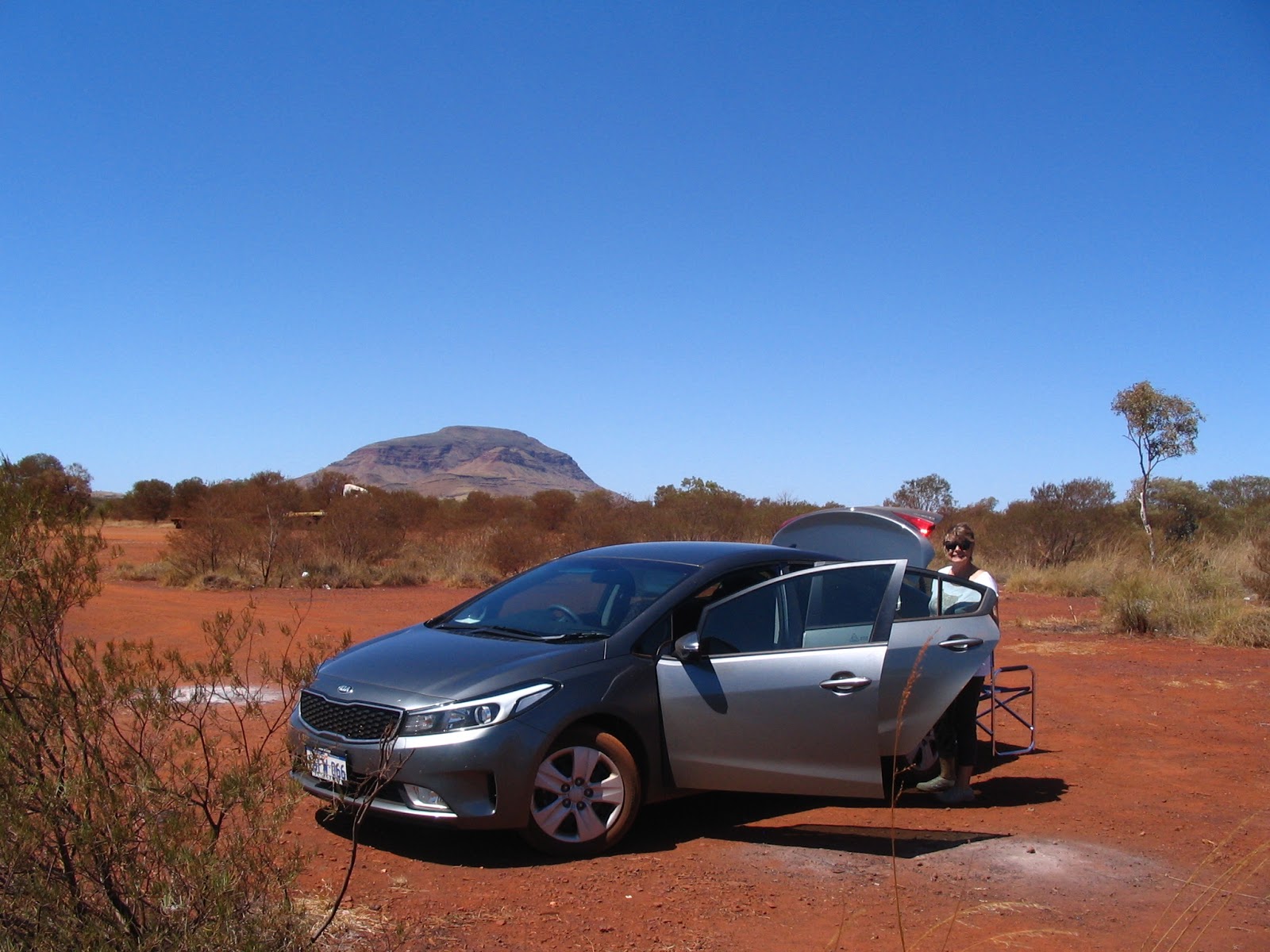
Last September, my wife, Lesley, and I travelled about 5000 kms in a two-wheel drive, 2 litre, Kia Cerato, from Ocean Reef to Point Samson and back. We explored Karijini National Park and parts of Millstream- Chichester National Park. It was a long, but very comfortable journey in our small sedan. I told friends who were interested, and even those who weren’t, that it was akin to flying across the Pacific Ocean in a Tiger Moth. Well, maybe not quite, but Lesley and I did have excited feelings about the adventures awaiting us as we set off in our small car in search of fabulous Western Australian wildflowers and wonderful scenery.

The main roads, apart from a stretch under repair at Bindoon, were very good. The dirt roads east of Pindar, near Mullewa, where the fabled Wreath Flowers grow, were smooth and comfortable. The dirt roads in Karijini were driveable. However, the same could not be said for those in the Millstream-Chichester National Park.
Lesley and the Cerato in the Pilbara,
I drove around Millstream in 2008 in a two-wheel drive Holden station wagon with no trouble at all. However, this year, when we reached Python Pool, we were warned by two four-wheel vehicle drivers from Karratha, that the roads further on to the Millstream Homestead and surrounding beauty spots were not suitable for two-wheel cars. They told us the roads were so corrugated that they were not even suitable for four-wheel drive vehicles that were towing caravans. Sadly, we returned to Karratha.

Tom Zaunmayer says that for four-wheel vehicle drivers “the rough and tumble journey is the destination.”  Well, good luck with that, Tom and I know how you feel. On the other hand, Millstream-Chichester National Park is one of Nature’s great destinations. After all, this is not the 1940s or 1950s. It is not even the 1960s. It is 2019, almost one fifth of the way into the Twenty First Century. All of our national parks should be sealed or at least very well graded on a regular basis.
  
It is a great shame that the roads in the Millstream-Chichester National Park  are not maintained well enough, or regularly enough, to enable two-wheel vehicle access for the great majority of Western Australian drivers.