Katoomba, the largest town in the Blue Mountains,
is about a 90 minute drive west of Sydney. It started life as a coal mine in
the late 1870s but, because of the wonderful mountain scenery, soon became a
tourist centre. Katoomba is a native word meaning water falling over rocks and
there are plenty of waterfalls and cascades to merit that description.
After a trouble free run out of Sydney, thanks to the
excellent navigational skills of lovely Navigator Lesley, we arrived in
Katoomba around 12-30pm. We were in a Ford FG Mark11 Falcon, which was a spacious
and comfortable vehicle with all sorts of bells and whistles. As we were keen
to depart Sydney as quickly as possible I did not waste too much time exploring
the various capabilities of the car. I managed to start it and get the radio
and the air conditioning to work, but as we crossed the ANZAC Bridge onto the
Great Western Highway I realised that I had no idea how to open the boot or the
petrol cap. Fortunately, these were not too difficult to operate.
Captain Arthur Philip planted the British flag at Sydney
Cove in 1788. That first European
settlement in Australia consisted mainly of sailors, convicts and the
soldiers who guarded them. After a shaky start in which everyone almost starved
to death, the colony gradually established itself. At first they had relied on
supplies brought from Britain by ship. Eventually convicts, with rudimentary
farming skills, began to grow enough food to support the settlers.
After a while, free settlers arrived and began to extend
farms out into the hinterland. However, continued growth was blocked by the
impenetrable sandstone barrier of what the locals called The Blue Mountains,
100 kilometres to the west. Why the BLUE
mountains? Well they were thickly covered with eucalyptus trees which gave off
tiny droplets that caused blue light from the lower end of the spectrum to
disperse into the atmosphere, creating a blue haze. It is the exact same reason
that dust particles in the atmosphere make our skies appear blue. The Blue
Mountains were a giant wall that trapped the settlers on the enclosed narrow
coastal plain. For twenty five years, until 1813, every attempt to cross the
Blue Mountains ended up with the explorers facing 1000 foot high cliffs. The
local indigenous people, who had lived in the area for around 60 000 years,
knew several ways to cross the mountain barrier but nobody thought of asking
them.
Then in 1813, Blaxland, Wentworth and Lawson, tried a new
strategy. Instead of walking along the valleys and coming to a dead end, they
decided to walk along the ridges. Eventually, they were successful and crossed
the mountains. As Andrew “Banjo” Patterson” so eloquently put it, they then “gazed
upon that vision splendid of the sunlit plain extended.”
Pretty soon farmers
and squatters were taking up land well to the west of Sydney. It was basically along the direction of that bush track made by Blaxland, Wentworth and Lawson in 1813, that Lesley and I cruised,
ever so comfortably towards Katoomba, on the well paved Great Western Highway.
Just outside of Katoomba, at Faulconbridge, we stopped to
visit the studio and picturesque rural property
of Norman Lindsay. Born in 1879, Lindsay was the Australian
precursor of Playboy's Hugh Heffner. Lindsay promoted the naked female form well before
Heffner was born. The property is dotted with many of Lindsay’s sculptures,
which are mainly of nude women. We had an interesting hour wandering around
Lindsay's home and studio and were given an informative commentary by a
volunteer guide.
 |
| The entry to Norman Lindsay's Studio at Faulconbridge. |
Lindsay was a very bohemian character and made a
speciallity of drawing voluptuous nude ladies. He even ditched his first wife to
marry his second wife, Mary Soady, who was one of his statuesque nude models.
Mary was chiefly responsible for producing his etchings, as Lindsay lacked the
physical strength to turn the large wheel on his printing press. In the 1980s a
movie was made about his life called “Sirens”, starring Sam Neill as Lindsay
and Elle MacPherson as one of the many nude ladies who frequented his studio. Our
very knowledgeable guide said Sirens was a totally inaccurate depiction of
Lindsay’s life.
Lindsay’s full bodied, sexy nude drawings were highly
controversial. In the 1940s Rose Soady took sixteen crates of his paintings,
drawings and etching to the United States for safe storage from the war.
Unfortunately, in America, the train on which she was travelling caught on fire and his
art work was impounded. When the authorities saw the nature of Lindsay’s art they destroyed it, saying that it was pornographic. When he heard what had
happened Lindsay is reported to have said, “Don’t worry. I’ll do more.” Norman Lindsay died, aged 90, in 1969. He was
an interesting character from an interesting family. You can find out more by a Control/Click on this
link:
When you are travelling you like to be well organised and
well prepared. Sometimes it backfires.
I chose our motel, via the internet, because it was
centrally located in Katoomba's Main Street, which is in fact, Katoomba Street.
The hotel is called Katoomba Town Centre Motel. However, when I swung into
Katoomba Street we came to a road block and a major detour right in the centre
of Katoomba Street. They were building a very big roundabout at the very intersection
on which our motel was situated and roads in four directions were blocked off for
about 50 meters. After following the detour signs we eventually came to the
other end of Katoomba Street and then doubled back to our motel. As you will
read subsequently, this was not the only time our travel plans were
thwarted by unexpected road closures.
After booking in and dragging our cases up two flights of
stairs, we decided to wander downtown for some lunch. We noticed a lot of Chinese,
Japanese, Thai and Korean food outlets mixed in with the usual cafes and
restaurants. The large number of Asian food outlets reflects the fact that these
days an increasing number of tourists are from Asia. In general, Katoomba
looked a little bit tired and in urgent need of sprucing up. Maybe it is a
result of the Global Financial Crisis, but it is clear that the tourist
industry is obviously not as profitable as it was previously. Having said that, we did
notice large numbers of Japanese, Chinese and American tour groups as we moved
around.
After lunch we did a bit more walking before returning to
the motel to sort ourselves out and have a bit of a rest. About ten minutes
later the fire alarm went off. We quickly went out in the car park trying to
find out what was going on. Then a fire truck turned up. I couldn’t see any
smoke, but I could smell that acrid aroma that occurs when something like a toaster
or electric kettle fuses.
 |
| Our friendly fireman at the back of the motel.. His mates are inside tackling the problem |
 |
| The crisis is over |
A couple of firemen, dressed up in all sorts of
protective clothing and masks, went into the building. We started talking to
another fireman who was unrolling some hoses. He did not seem too concerned and
I said, "There is no smoke."
He gave me a smile and said, “Well, that is always a good
sign." Later on he told us a dryer in the laundrette had fused and started
smoking but his firey mates had handled it all.
 |
| The burnt filter and some other burnt matter from the faulty dryer. |
Earlier, I had walked around the motel looking for smoke. I didn't see any, but
I did notice a rather grand stained glass window over the main entry door. At
the top of the door the coloured glass spelt out, "St Elmo". Well, I
guess that says it all, really.
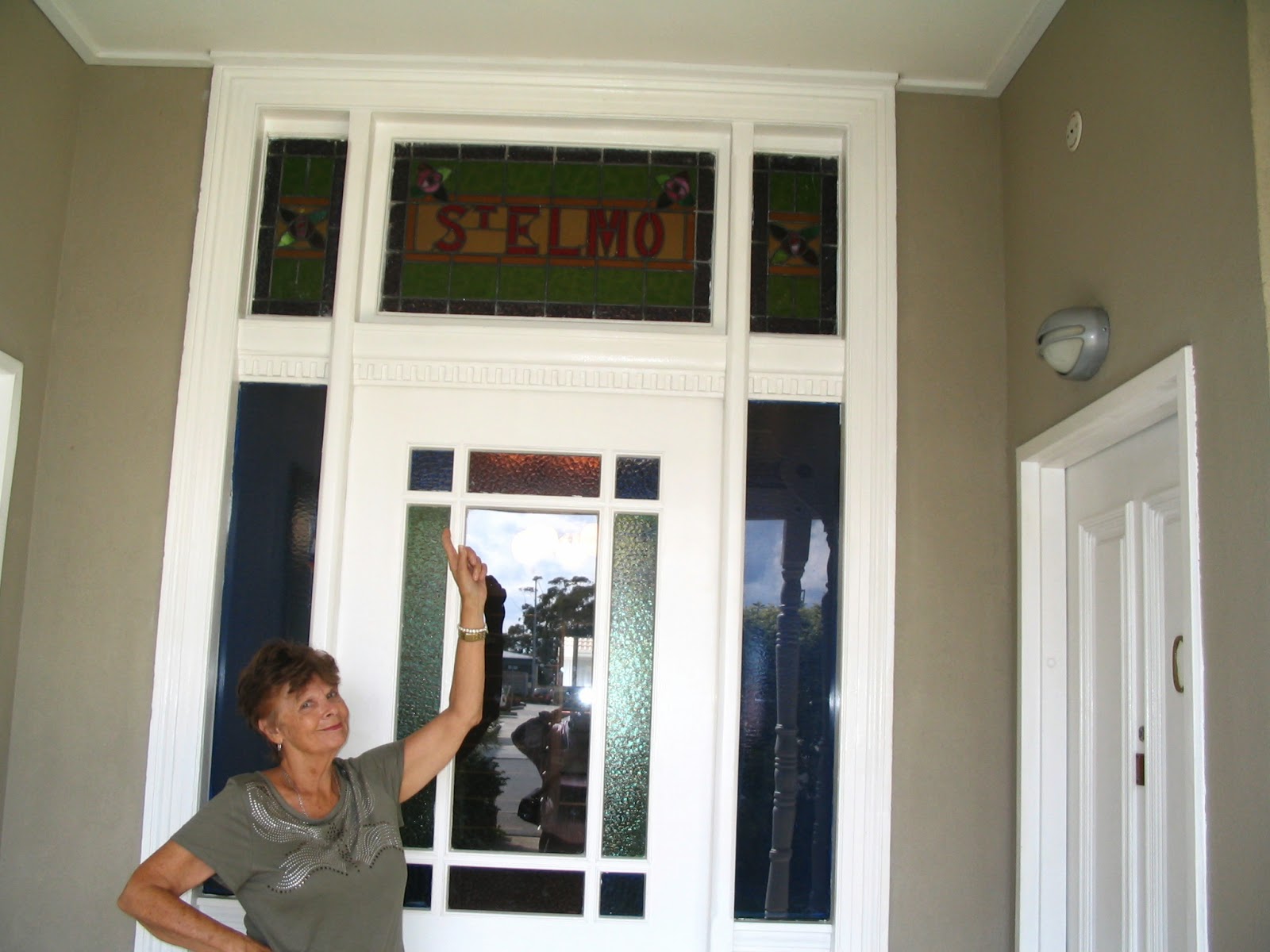 |
| We were there when St Elmo's fire took on a whole new meaning. |
About 4-30pm we set off to see some of the fabulous Blue
Mountains. We immediately noticed that the previously blue skies were now filed
with threatening black thunder clouds. We drove about two kilometres to Echo
Point to the Three Sisters lookout. According to an Aboriginal Dream Time story
the Three Sisters represent three young maidens who were in love with three
boys from a neighbouring tribe. Their marriages were opposed by both tribes and
a war broke out. In order to protect the girls from the war, their mother
arranged for them to be turned into stone. And there they have stood so
beauteously ever since. Despite the dark and gloomy outlook overhead, the Three
Sisters stood majestically as they ever have for thousands of years. The
scene certainly impressed the very big number of Asian and American tourists
who were all standing around taking photos and being photographed with the Blue
Mountains in the background.
 |
| The Three Sisters at Echo Point as storm clouds gather. |
After I had taken a few pictures a young American asked
if I could take a picture of him with his friends. There were about ten of
them, all young and very fit looking. He handed me his camera as his mates all
lined up for the picture. I took the camera and jokingly said, “There could be
a small fee for a group sitting.” His friends all laughed.
He looked at me, then smiled and took his place in the
group. After I had taken a couple of photos the group thanked me and slowly
moved away. As he retrieved his camera, the young man smiled again and
called out, “Hey, Billy, pay the man.” I guess Billy did not hear him.
Lesley remarked that this group of young men looked like
the American baseball players she had seen featured on TV the day before. This
could very well have been so, because on the next weekend in Sydney, two US major league teams played games against two Australian baseball teams and then they played each other in an official major league game at the Sydney Cricket Ground. This
was why the Western Australia cricket team was playing the Sheffield Shield
Final against New South Wales in Canberra instead of at the Sydney Cricket
Ground. I tried to imagine the situation whereby two US Football teams would be
scheduled to play at the MCG on the last Saturday in September and the two AFL grand
finalists had to play their Grand Final in Geelong. Somehow, I don't think that will ever happen.
Shortly after the American baseballers' photo shoot, there was a
massive thunderclap. Obviously it was soon going to rain. As there were no interesting bars
nearby for us to take refuge in, we returned to the car and back to the safety
(barring the odd fire or two) of our motel.
The next morning we ventured down to Echo Point again. The
whole area was packed with tourists and school groups. Tour buses where
everywhere. Unfortunately the focus of all of this attention, the Three
Sisters, was completely shrouded by a thick blanket of fog. I felt terribly
sorry for the tourists, especially the schoolchildren and their teachers who
had missed out on what was to be the highlight of their excursion. I was reminded of the time my sister, Valerie, travelled to the Blue mountains with her English born husband, John. John had never been to the Blue Mountains before and was disappointed when he and Valerie arrived to find everything covered in fog. Valerie änd John drove back into town. Valerie led him into a newsagent's shop. She found some large postcards of the Three Sisters and other scenic places, thrust them in front to John and said, "This is what you would be seeing if the fog wasn't there."
Later in the morning the fog lifted and we drove around Blue Mountains Drive, stopping at various vantage spots to enjoy the grand views and the ambient tranquillity of it all. It was amazing to see that even in this wilderness there were very well established houses in the National Park. I imagined the occupants of these minor mansions at breakfast time, eating their corn flakes as they gazed out on million dollar views.
Later in the morning the fog lifted and we drove around Blue Mountains Drive, stopping at various vantage spots to enjoy the grand views and the ambient tranquillity of it all. It was amazing to see that even in this wilderness there were very well established houses in the National Park. I imagined the occupants of these minor mansions at breakfast time, eating their corn flakes as they gazed out on million dollar views.
 |
| The Three Sisters shrouded by the morning fog. |
After some more sightseeing we had lunch in the beautiful
town of Leura. Here we found a picture postcard main street with a median strip
of cherry trees. On both sides there were very well presented shops selling food, clothing, jewellery and knick knacks of various kinds. Leura is
the native word for lava. There is some lava in the area, but I am reliably
informed that the last volcanic activity occurred about ten million years ago.
Leura looked much fresher and brighter than Katoomba and
we soon discovered that there is a fairly intense rivalry between the two
towns. Our waitress in Leura was almost
ecstatic when we told her that we thought Leura was far prettier than Katoomba.
“Oh, it most definitely is,” she assured us, quickly adding, “and the people
are nicer too.” I had noticed that in Katoomba you would often see groups of
young men sitting idly by, smoking and indulging in noisy conversations. I wondered if maybe Katoomba had a drug
culture problem that Leura did not.
 |
| This is why the first settlers in Sydney found it difficult to move to the west. |
From Leura we proceeded east along Sublime Point Road,
aptly named, because after about twenty minutes we came to Sublime Point. After
a downhill walk of 250 metres from the car park we reached the Sublime Point lookout,
which offers magnificent views across the Jamieson Valley. We stayed here quite
a while, mainly to enjoy the serenity of the moment and the superb views, but
also to gather our strength for the 250 metre walk uphill back to the car. Some
things do come at a price!
 |
| A view from Sublime Point. |
 |
| Another sublime view. |
On our final night in Katoomba we decided to eat out at
the Katoomba RSL Club. In Western Australia we do not have poker machines,
except at the Crown Casino at Burswood. So our Returned Services League clubs
are rather spare. They may have an occasional alcohol licence for Friday night socials
or other gatherings. Their income is mainly from bar sales, chook raffles and
hall hire. In the eastern states, poker machines are legal and they are everywhere. The constant flow of casino money enables places like Returned Services League clubs to
provide very luxurious club room facilities for returned service men and women
and their guests. A feature of all of these clubs is the very inexpensive food
and drink which you can enjoy before, during and after putting your money into
the pokies. Of course these RSL clubs also welcome passing strangers who are
able to obtain a Visitors Membership Card merely by producing some
identification and signing a form. There is no membership fee. Of the people in the dining room that evening I would say more than 50% of them were travelling nomads like Lesley and me. I know that these travelling people are usually called "grey haired nomads" but Lesley and I are not quite at that stage yet.
While enjoying some pre dinner drink in the well
upholstered RSL lounge I gazed into the adjacent dining room. I was astounded
to see that the franchise for the catering section of the Katoomba RSL had been
handed over to the Japanese. I immediately thought of those gallant old diggers,
who fought and died on The Kokoda Track defending Australia in 1942, turning in their graves at the fact
that the Japanese were now serving up the food in Katoomba’s RSL. Lesley
assured me that the Asian people serving in the restaurant were in fact Chinese.
Later we went in and I enjoyed a very large Chinese meal of Roast Lamb and three vege.
We thoroughly enjoyed our Blue Mountains visit. The next
morning we set off bright and early to drive to Canberra, via the hair raising hair pin bends that lead down, way down, from the Blue Mountains to Jenolan Caves.
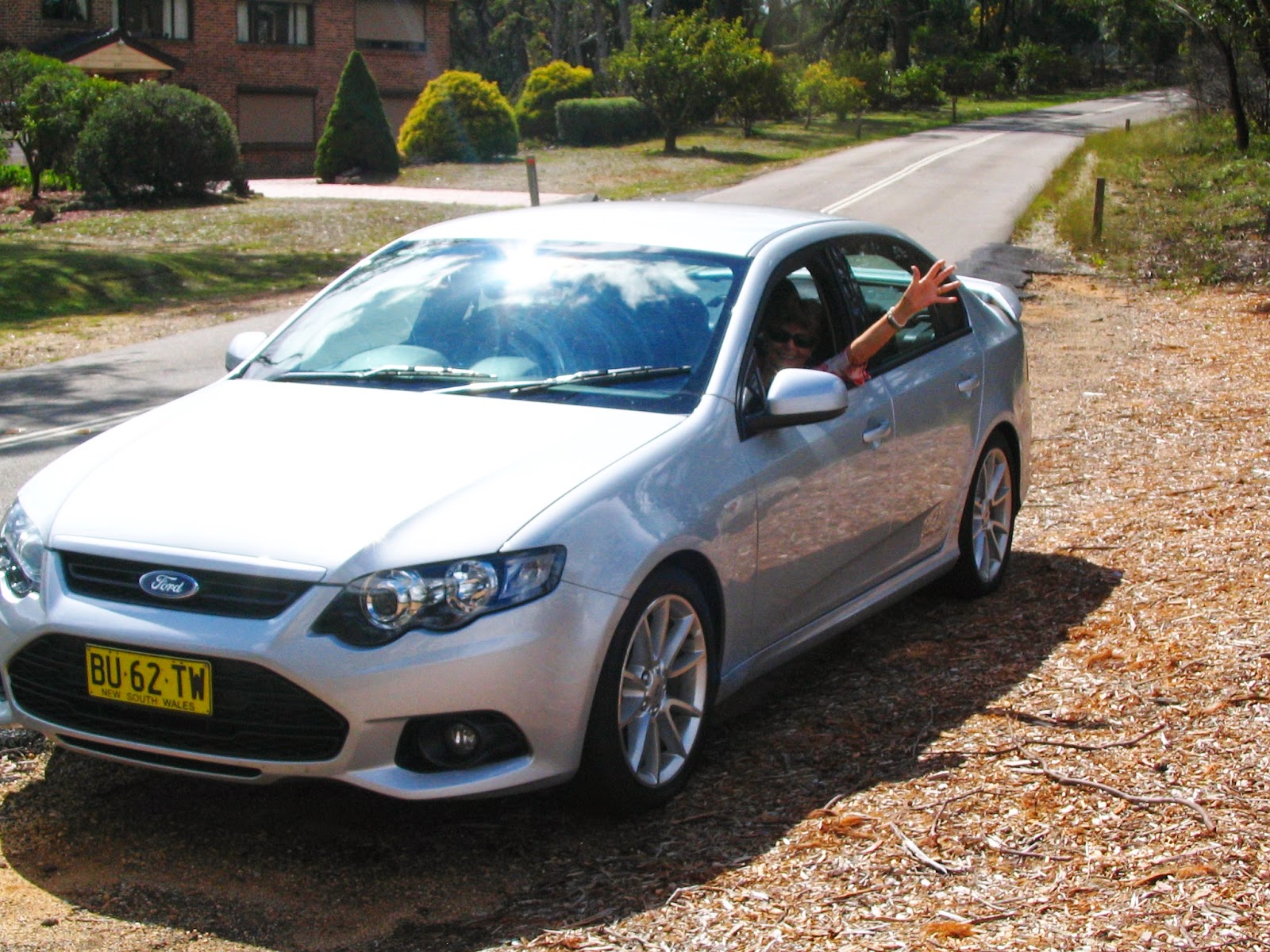 |
| On Blue Mountains Drive. One of the well placed houses in the background that overlooks a magnificent view. |


